For my Final outcome I want to incorporate a mix of manipulation and the sky, using a prism makes this thought a reality. The prism creates an optical illusion by showing multiple of the same thing so for my project it will be the sky and the intensity of the colours in it that are able to be captured. I intend to use a projector to distort my photos through a prism and to have them exhibited on a wall in a human-made natural environment.
Looking at Elena Kulikova
Elena Kulikova uses prisms in her work to create unique and ethereal images that end up manipulating light and leave the photo containing dreamlike characteristics and visual factors. By bending and refracting the light in crazy ways, her photos are left with a sense of magic and wonder which leaves the subjects of her photos with a sense of etherealism.
The way Kulikova uses a prism enhances the emotions within the photo. By playing around and experimenting with light and colour, she was able to trigger feelings of nostalgia and romance.
Kulikova uses prisms to add layers and complexity to her shoots, the use of multiple perspectives adds a metephorical layer too as it can draw the viewers eyes to multiple parts of the photo depending on what kind of prism was used and how that may refract and reflect the subject and light.
Kulikova can constantly be seen to be pushing herself out of the boundaries of her work, by experimenting with different reflective materials and seeing how they differ from each other. By experimenting, she has now found a feature that can be found in most of her photos, this has also helped her create surreal settings which often leads to her capturing moments that seem to exist in an alternate reality.


Initial Prism Experiments
I am using prisms in this project because i think that the sky has dimensions on its own, the clouds, the sun, the weather change but i thought about how i could adapt this and make one photo representing all of the features the sky may have. the prism deep dives into the multiple photo idea i had without huge amounts of editing as it is practically pre done and simple to create basic compositions that look interesting without editing.

This photo has different shades of blue that also contain quite harsh greys and bright whites, the clouds act as a foreground and the subject where as the sky is a back ground, the trees can also be seen to frame and shape the photo and transform it by adding shapes and lines that can be seen to start converging.
i found the disconfigured tree had aligned again within the prism too, this interested me as even with the new perspective some things were kept the same.


Prism photoshoot 2
This is my second prism photoshoot, i wanted to incorporate the shapes and lines within these so i used the design on a window to help add to the perspective of being inside looking out and feeling trapped. I wanted these photos to provoke emotions and almost leave viewers feeling trapped within the photo and not knowing how to perceive it. I also feel that although these photos are all taken in the same location they all tell different stories and focus on different aspects of the photo.


www- this photo is close up so doesnt have too many external factors affecting the final photo, the sphere contains a mechanism of flipping the objects a full 180 degrees to give the photo more of a distortion. The cropping of this photo makes it that the whole sphere can’t be seen and only a small faction of it has any object in it.
ebi- next time i use the sphere when taking photos, i will try to incorporate the whole thing to give a wider distortion and manipulation of the surrounding environment as this photo does limit what can be seen and how it is changed according to the angles and how i edit it afterwards.
Sphere
These photos are focusing on the sphere and the affect this has, the flipping of the environment whilst also surrounding it by the natural setting is a really interesting form of manipulation and change as you can see what it could look like if there was no sphere in place.
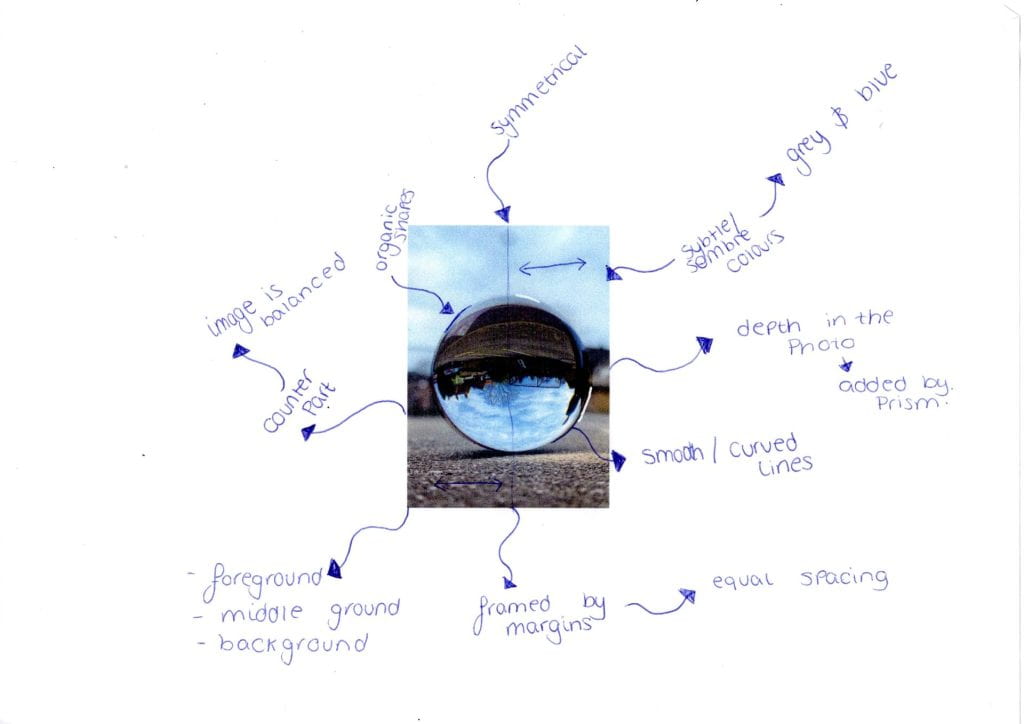
www – These photos created a contrast between where the sphere was placed and what is able to be seen through it, it also includes the bright colours from the sky and how that can affect the photo itself and in this case it creates a simple relationship between the brown background and the blue found in the sky.
ebi – these photos are all very similar as they were taken in the same setting, but by moving around and taking similar photos somewhere else may give them a different feeling to these original shoots i have done.


Digitally Adding More Layers and Dimensions
For this area in my project, I wanted to add more dimensions to my photography through digital manipulation. I will use photoshop to add further manipulations to my photos i took using a prism as i want to create an unusual imagine that can appear quite busy and has alot going on so that the whole photo is interesting not just one specific part. This links to the sky as it may be seen as a further distortion as the sky already has features that are really interesting such as the optical illusion of the moon or sun following you everywhere.
Looking at Dafna Talmor‘s Constructed Landscapes II series and Gustave Le Gray
Gustave Le Gray
Gustave Le Gray was best known for his beautiful seascapes that were made up of seperate photos of the sea and sky to help dramatise the difference of lighting and detail in both settings. His best work was made up from his experimentation with the combininations of different photographic techniques to achieve a balance of exposures in his seascapes.
He was also well known for his portraits and landscape photographs, he documented historic landmarks and also captured photos of the french elite. He has influenced other photographers by using his skills when capturing light and the atmosphere. His approach to his photography emphasised the need to allow for unique artistic expression within photos.
He has also been recognised for his artistic and technical achievements within his photography, his ability to capture these serene landscapes helped discover photography as a form of art.
By taking seperate photos of the two settings, he was able to balance out the exposures of each to help achieve a harminous balance. The vision of the wave breaking in the foreground and the gentle horizon line in the background, the light and shadows create a false illusion that the wave is actually moving. He was able to capture the power and the serenity of the sea but also showing viewers how beautiful it is.
Dafna Talmore
Talmor takes a more physical approach to manipulating her photographs by cutting and placing them together as if they were all pieces of a puzzle containing different features from multiple different places and landscapes to create one photo.
The photos she makes often have an abstract quality that blurs the boundaries between reality and imagination, these produced landscapes that appeared well known to the viewers but also presents itself as unusual and out of this world.
Her photography invites viewers to perceive landscapes in a way that no other person would, to make each person have individual thoughts and feelings towards her work, these help her construct a reality based off of how others interpret her work and help Talmore herself see the vivid representation of space used in her work.
The techniques used help add depth and provoke viewers to question what Talmore has set out to do and to examine her work closely and breakdown all the elements involved in a composition. She also uses a unique colour palette made up of factors from different landscapes she photographed to create an original, one-time aesthetic.

Visual Analysis
This photo contains organic curved lines that can be seen to differentiate each layer from the rest, the vibrant blue contrasts well with the white highlight and black shadows and also can be seen to increase the vibrancy of the dull sandy red shades that mirror the lines of the harshness of the black. This photo holds some similarities to my work as they all have built in manipulated layers that adds distortions and dimensions.


Gustave Le Gray – The Great Wave, 1857. Albumen print from collodion-on-glass negative.

Dafna Talmor – From the Constructed Landscapes II series. C-type prints made of collaged colour negatives
These photos describe quite harsh landscapes, they do however show emotions, most landscapes could be seen as calming but instead, these could be described as anxiety increasing as it is unknown what could happen next within the photo. Both of these photos contain what seems to be the sea, but both in different ways, one is taken from, straight on photo of the sea whereas, the other might not be the sea at all but just looks like it. These photos are also very different, the colours have been cancelled out in the first photo maybe showing how old it is or just the type of camera used, whereas, the second photo looks modern and like it is made up of multiple photos taken in the same place. some words to describe the first photo may include “out-dated, harsh, mysterious, open” whereas, the second photo could use words such as “enticing, colourful, unknown, manipulated”.
Gustave Le Gray – The Great Wave, 1857
‘The Great Wave’, the most dramatic of his seascapes, combines Le Gray’s technical mastery with expressive grandeur […] At the horizon, the clouds are cut off where they meet the sea. This indicates the join between two separate negatives […] Most photographers found it impossible to achieve proper exposure for both landscape and sky in a single picture. This usually meant sacrificing the sky, which was then over-exposed. Le Gray’s innovation was to print some of the seascapes from two separate negatives – one exposed for the sea, the other for the sky – on a single sheet of paper.
Dafna Talmor – from Constructed Landscapes II
This ongoing body of work consists of staged landscapes made of collaged and montaged colour negatives shot across different locations, merged and transformed through the act of slicing and splicing […] ‘Constructed Landscapes’ references early Pictorialist processes of combination printing as well as Modernist experiments with film […] the work also engages with contemporary discourses on manipulation, the analogue/digital divide and the effects these have on photography’s status.
These two pieces of text show the breakdown of techniques both photographers use, both photographers create one photo that contains multiple layers. Le Gray explains that he wanted to prove you could get a balanced exposure photo including the sea and the sky. Dafna Talmor wanted to incorporate more than one factor into her photos but she took a different approach to Le Gray, she physically changed and adapted her photos by cutting and replacing each element to create her composition.
I was really surprised to find out how Le Gray created such a simplistic shoot in the way he did, as visually it does look like just one photo with nothing else involved, but to then find out it was made from two photos to then balance the exposure gives this photo more depth. Talmore’s photos do look like they were one basic photo but got changed to then add distortions and layers, they look like pieces of a puzzle that haven’t been accurately placed which adds layers and more dimensions and views which can help evoke emotion.
To find out more about these techniques personally i believe a step by step guide and example of how a photo was made would broaden viewers understandings of how these photos are made. Another thing that may help could be knowing what kind of lens they used to shoot on, knowing this gives us alot of information about the photographer and can help show us how a composition like this may have been created.
Pictorialism is made up of lots of different photographic techniques, Both Le GrAy and Talmore can be seen using combination printing which is the idea of creating an outcome by combining different prints to create one photograph. Photographers would select certain elements from different images and combine them with elements from other images to go on to create a visually appealing composition. This technique allowed the photographer to have more creative control over the final outcome and allowed photographers to also manipulate the photo to match their initial idea. Another technique often used in Pictorialism is Vignetting this involves darkening the edges of a photograph to draw attention to the subject that would usually be in the middle of the frame this was used to create a sense of intimacy and focus within images. Slicing and splicing was a technique used by Talmore to create her complex compositions, she started by slicing her photos into smaller sections to make the features more distinct, after doing this she then would rearrange all the sections into an irregular pattern almost to make sure they didnt look like they were in the right place, by doing this she was able to blend her the elements of the landscapes she photographed to create her compositions.
Takeaway Point
Using Photoshop allows for changes to be made to a photograph, similarly to Talmore i want to add dimension and allow for multiple perspectives within one photo, using a prism in my work will help draw focus to multiple things in the photo not just one factor. The concept of Photoshop is also very similar to the techniques used in the photographic style of pictorialism, Talmore’s idea of slicing photos and rearranging them can now be done using technology which makes it more beneficial and leaves room for trials and errors.
Initial Photoshop Experiments
These photos are all experiments of me using Photoshop and layering my prism photos over the top of each other. These are inspired by the work of Talmore and Kulikova they both use dimension and light to help make their photos more visually interesting. I wanted to try doing this as it can help ‘fix’ the photo if it didn’t match my initial idea, when I first thought about using prisms I did imagine multiple things occurring at once in the photo and when I did my initial shoot it didn’t work out that way, once I learnt the techniques and processes in photoshop I knew this could help build my work up to fit the ideas I had.

Visual Analysis
In this photo, you can see the light that has been reflected through the prism which has left harsh white highlights within the photo at different points and there is almost a visible atmospheric layer that can represent dreams and etherealism.


Looking at Aletheia Casey
After reading about Aletheia Carey’s work that focused on the COVID pandemic, her unique breakdown of photos and her ability to reconstruct them in a similar way that can also look 3D so they can seem really real. Her photos also carry quite a heavy meaning, they could be seen to represent loneliness which would’ve been an accurate feeling for most people during the pandemic. Her focus on isolation in everyday life was really unique but she was still able to use techniques similar to other photographers i have looked at, her multiple photos in one were very similar to Le Grey and Talmor to help create a balance within the photos.


Visual Analysis
This photo looks surreal and almost as if it’s from a different reality, there is a mix of geometric and organic shapes that can be seen to fit a pattern followed by grey mid-tones and black shadows, this photo could be described as an ombre as the tones get darker as you go down the photo, the vibrancy of the fiery red tones in the middle of the photo really can be seen to act as a focal point as it could also have a metaphorical meaning of isolation as it is the only vibrant colour seen.


Takeaway Point
The breakdown within all of her work will help me refine my layered prism photos to help create a final outcome that has meaning and can show viewers the thought behind it and the emotions gone into it. The effort and emotion shown through all photographers work has impacted my photographer and has helped me understand how important it is to leave a mark on the viewer and make them understand the dynamic and difference between each piece of work and how the emotions can also affect the way it is understood and seen.